

India Burns 23 Million Tonnes of Farm Waste Every Year. Here Is Why.
Stubble burning is one of India's worst recurring air quality crises. The economics behind it are simple. The solution is harder than it looks.
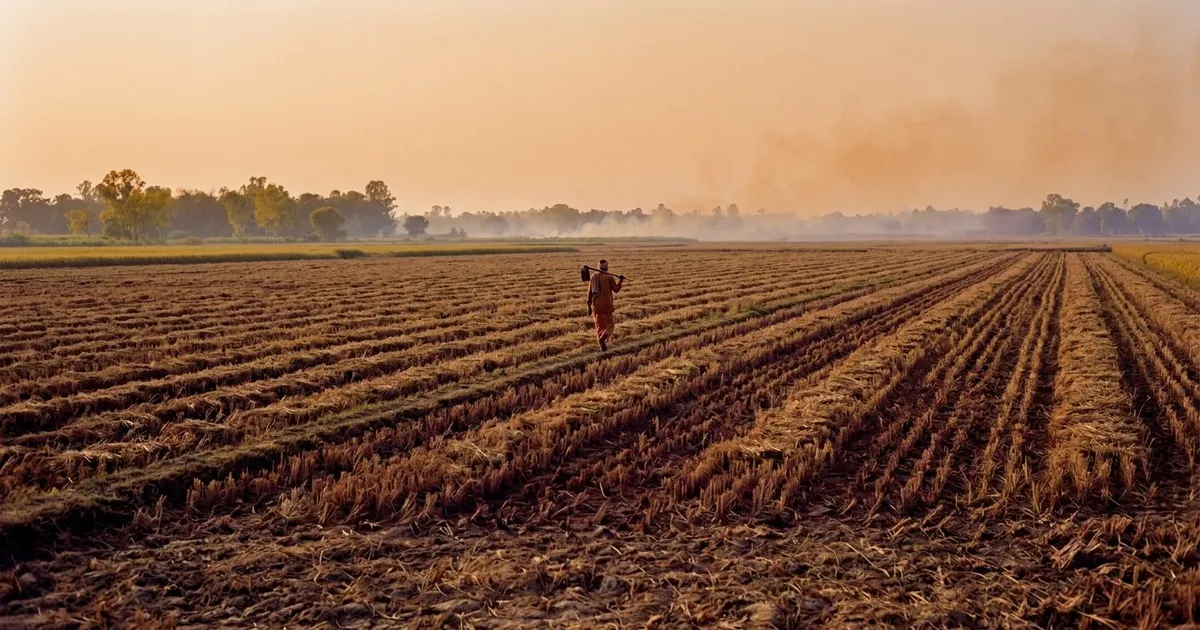
I have driven through Haryana in late October — windows up, headlights on at 3 pm — and watched the sky turn the colour of tea. Every year between October and November, satellite images of North India show a continuous belt of fire across Punjab, Haryana, and western Uttar Pradesh. It is not forest fires. It is farmers burning rice stubble on their own fields.
The practice accounts for roughly 25 to 30 percent of Delhi’s air pollution during peak seasons, according to studies from IIT-Delhi and TERI. It is illegal under the Air (Prevention and Control of Pollution) Act. Farmers still do it, year after year, because the alternative is worse for them economically.
Why burning is the rational choice for farmers
After a rice harvest, the field has to be ready for the next crop, typically wheat, within two to three weeks. Rice stubble is tough, fibrous material. Breaking it down mechanically requires equipment most small farmers do not own or cannot afford to hire on short notice.
The economics work like this: burning takes one day and costs nearly nothing. Mechanical stubble management using a Happy Seeder or rotavator costs between Rs 2,000 and Rs 4,000 per acre and takes more time. For a farmer with 5 to 10 acres and a tight window before the next planting season, burning is not laziness. It is a rational financial decision under the constraints they are working with.
Government subsidies exist for Happy Seeders in Punjab and Haryana, but uptake has been partial. The scale of the problem, 23 million tonnes of crop residue burned annually across India, indicates that subsidies alone have not closed the gap.
Where rice husk fits in this picture
The residue that matters for our product is not the straw left in the field. It is the husk that is removed during rice milling, before the grain reaches consumers.
Rice milling generates two by-products: rice husk (the outer shell, about 20 percent of paddy weight) and rice bran (the thin inner layer between husk and grain, about 8 to 10 percent of paddy weight). Both are removed before rice reaches your kitchen.
These mill by-products have a better collection infrastructure than field stubble, because they are generated at fixed locations (mills) in concentrated volumes. The challenge is not collection. It is finding end markets with enough volume to absorb the supply.
India’s rice mills process over 100 million tonnes of paddy annually. That generates roughly 20 to 22 million tonnes of husk and 8 to 10 million tonnes of bran every year. Current utilization includes power generation (husk combustion), silica extraction, and animal feed (bran). Tableware is a small fraction of total use today.
The honest scale question
We are a small manufacturer. Our current production absorbs a fraction of a fraction of the available husk and bran supply across India. That is not a marketing disclaimer. It is the actual state of the industry.
The agricultural waste problem in India is structural and large. One company making biodegradable plates does not fix it. What changes the picture is a combination of viable end markets, functional procurement infrastructure at the mill level, and sufficient price signal to make husk and bran collection economically worth doing rather than discarding.
We are building one end market. There are others being built elsewhere: construction composites, packaging material, fertilizer input. Each one adds a small pull on a supply that currently has too few buyers.
What this means when you buy Aura products
When you choose rice husk tableware over pulp or plastic, the material choice has a supply-side effect. The husk used in your plate would otherwise have been burned, dumped, or at best used for low-value fuel.
That is a real difference. It is not carbon-neutral manufacturing and it is not a solution to stubble burning at scale. But it is a genuine redirection of agricultural waste into a durable, food-safe product, which is a better outcome than the alternatives currently competing for that material.
Aura Farmers tableware is made in India, from rice husk and rice bran sourced across diverse agricultural regions. FSSAI food-safe certified.