

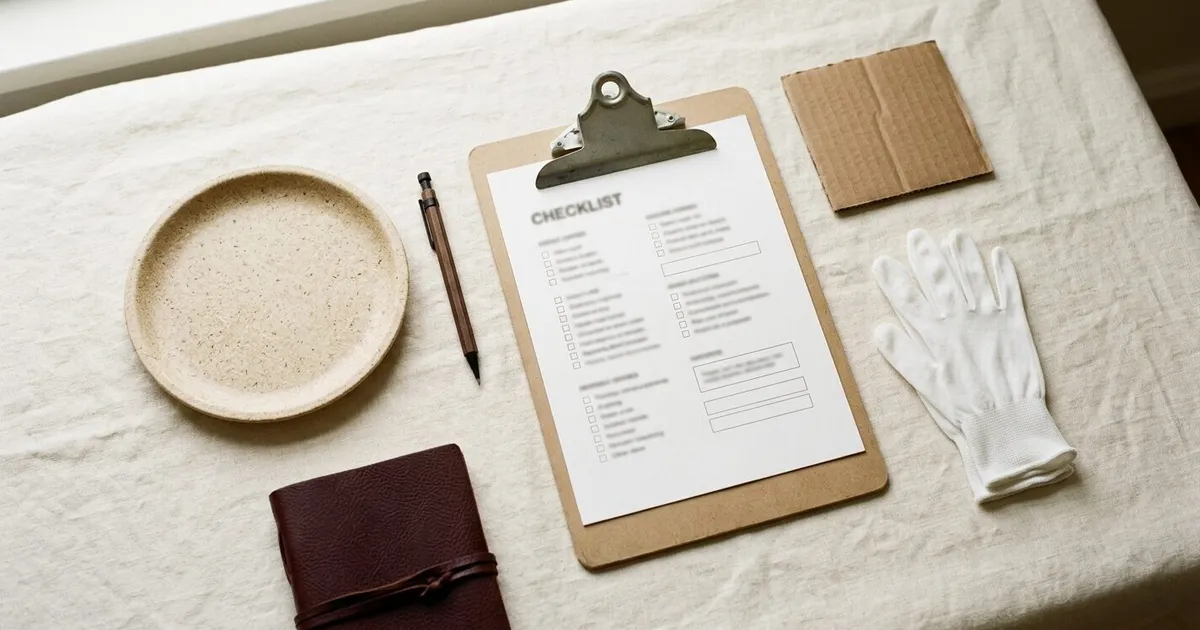
Bulk Tableware Procurement: A Checklist for First-Time B2B Buyers
First bulk order for an event or institution? Here is what to confirm before committing to a supplier, a product, and a price.
Most of the first-time bulk buyers who contact us are nervous — and they are right to be. A 10,000-piece order that does not work for your use case is a more expensive mistake than a 50-piece pack that disappointed you at home. The unit economics are better at scale, but so is the error cost.
This checklist is the one I wish every new buyer had in front of them on our first WhatsApp exchange. It covers what to verify before committing, in the order you should verify it.
Before you contact any supplier
Know your volume accurately. Estimate based on covers served, not attendees. At a buffet, one guest may use two plates (starter and main). At a plated dinner, it is one. The difference matters at scale. Add 8 to 10 percent buffer for breakage and waste.
Know your menu. Wet food, dry food, both? Maximum serving temperature? Whether plates will be used for reheating? These answers determine whether a given product category will work for your use case.
Know your timeline. First orders typically have longer lead times than repeat orders while the supplier sets up your account and confirms production availability. If you need 5,000 pieces in four days, that is a different conversation than 5,000 pieces in three weeks.
Evaluating the product
Request a sample before placing a large order. Any legitimate bulk supplier will send samples. Test the samples under your actual use conditions: fill a plate with the wettest food on your menu, let it sit for 15 minutes, apply pressure to the centre, and see what happens.
Check the dimensions. Plate dimensions (diameter, wall height, base width) affect how they stack, how much they hold, and whether they fit your chafing dishes, tiffin stacks, or serving lines. Get the exact specifications in writing and confirm they match your operational requirements.
Verify food contact safety. Ask for the FSSAI certificate or food contact safety test report. Confirm the certificate is current (not expired) and covers the specific product you are ordering.
Check pack configuration. How many pieces per carton? What is the carton weight? Do the dimensions fit your storage space and delivery vehicle loading? These logistics questions seem minor but create real operational friction at scale.
Evaluating the supplier
Minimum order quantity. Some manufacturers have MOQ thresholds that do not make sense for smaller operations. Confirm the MOQ for standard pricing and whether smaller quantities are available at a different price point.
Lead time from order confirmation to dispatch. Get this in writing, not as a verbal estimate. For repeat orders, lead time often shortens once you are an established account.
Payment terms. Most B2B tableware suppliers work on advance payment for first orders and may extend credit terms for established accounts. Know what the terms are before ordering.
Delivery coverage. Confirm the supplier ships to your location and understand who bears the freight cost. For orders above a certain value, some suppliers offer free delivery within specific zones.
Return or replacement policy for defective goods. If a carton arrives with significant breakage or the wrong product, what is the process? Get clarity on this before you place the first order.
Pricing questions worth asking
Volume break points. Is there a price difference between 1,000 and 5,000 pieces? Between 5,000 and 10,000? Understanding the volume curve helps you decide whether it makes sense to order more at once.
Multi-SKU orders. If you need plates and cups and bowls, does the total volume across SKUs count toward volume pricing, or is each SKU priced independently?
Freight calculation. Is freight calculated per order or per carton? This affects the economics of ordering in full-carton quantities versus mixed quantities.
Before the order ships
Confirm the exact product codes, quantities, and delivery address in writing. If there is any ambiguity about what was agreed, resolve it before the order ships, not after it arrives.
For first orders with a new supplier, a brief confirmation call or message before dispatch is not excessive caution. It is standard practice.
Aura Farmers handles B2B inquiries directly. For samples, volume pricing, and delivery timelines, contact us on WhatsApp at +91 81403 47773. We respond within 24 hours on business days.