

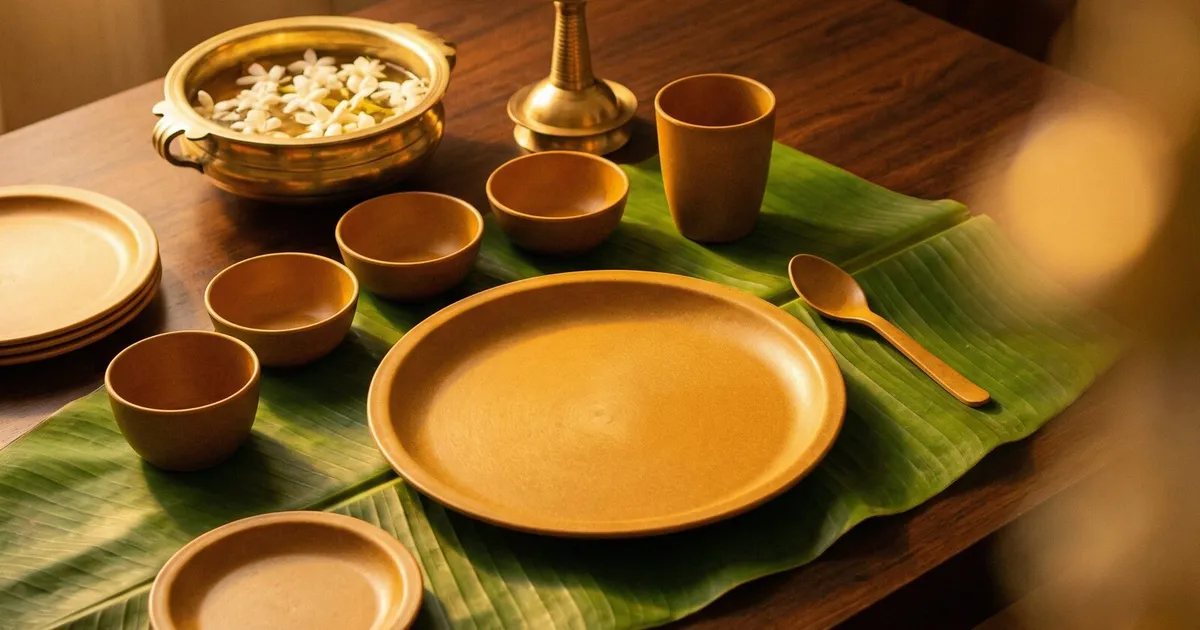
A Complete Guide to Aura Farmers Tableware
Every product we make, what it is built for, and how to pick the right one for your event, canteen, or home. A plain-English catalog walkthrough.
This guide is for anyone who has landed on our catalog and is trying to work out what to actually order. I’ll go through each product, what it’s designed for, and the failure modes we see when the wrong one is picked for the wrong use case.
Before getting into specifics: all Aura Farmers tableware is made in India, from rice husk and rice bran compression-moulded without additives. No synthetic binders, no plastic coating, no bleaching. FSSAI-compliant for food contact. Shelf life of 12 months in dry storage. Decomposes in 60–90 days after use in composting conditions.
Plates
Three sizes. Same material. The choice is about what is going on the plate.
7-inch plate. Snack and starter plate. Best for samosas, chaat, dry snacks, tikkis — foods where moisture stays in the food, not on the plate. If you are running a tea-break station at a corporate event or a pav-bhaji counter at a wedding, this is the size.
10-inch plate. The workhorse. A full-meal plate that holds up under gravy-heavy menus. This is the plate most event caterers order in the largest volumes. It fits a standard Indian dal-rice-two-sabzi-roti meal without feeling cramped.
12-inch plate. Thali and banquet plate. Use this when you are serving a full thali with separate compartments (bowls on the plate) or a buffet where guests are loading their own plates. The extra diameter matters when food is being placed, not served.
Wrong-plate failure modes: ordering 7-inch when the menu has gravy (food slides off the rim into the guest’s lap). Ordering 10-inch for a thali service (not enough space for the bowls). Ordering 12-inch for a snack counter (guests take more than they eat and waste goes up).
Bowls
180 ML bowl. Our standard bowl — sized for chutneys, dry snacks, and semi-solid sides like raita or sambar. Works well in thali setups and as a standalone snack bowl.
200 ML shallow rim dish. A wider, shallower profile than the 180 ML bowl. Best for curry-style servings where you want more surface area than a deep bowl provides. The raised rim keeps gravy contained.
The distinction matters if you are running a thali-style service: the 180 ML bowl holds sides, and the shallow rim dish holds the main curry.
Cups
120 ML cup. Chai and espresso-sized. For single-serve hot drinks where the guest will finish the cup within a few minutes. Do not use this for cold drinks that sit.
250 ML cup. Standard tea/coffee cup, also suitable for short-duration cold beverages. Same caveat as the 120 ML — the material is not designed for extended contact with liquid.
Important caveat on all cups. The material is paper-adjacent in its behaviour — it holds hot liquids well for the duration of a normal cup of chai or coffee, but leave any cup full on a table for 20+ minutes and you will see softening. For event service where guests receive, drink, and dispose within a reasonable window, cups are the right choice. For cloud kitchen dispatch where a drink sits in transit, they are not.
Trays
Large round tray. Designed for shared platters and buffet service. The wide rim keeps liquids contained, which is the main structural difference from a plate. Use this for fruit platters, shared starters, or as a base for smaller items in a buffet layout.
We currently make one tray variant. If you have a specific tray format you need for an institutional order (rectangular, sectional), contact us — we have done custom runs for large institutional buyers.
Cutlery
13 cm spoon. Our only cutlery product right now. Firm enough for rice and semi-solid foods, not recommended for sawing through hard items. Works well paired with the 10-inch plate for rice-and-dal service.
Combo sets
Dinner combo set. A pre-packaged bundle of plate, bowl, and cup. For caterers who want to reduce SKU management and for institutional buyers placing smaller orders where coordinating individual components creates more overhead than it is worth. The combo is priced and packed as a unit.
How to pick a pack size
Our standard packs range from 50 pieces (larger plates and trays) to 240 pieces (smaller cups). For a single event, multiply expected guests by courses-that-need-a-plate. For a canteen, think in two-week cycles — most canteen managers find fortnightly delivery cycles match their storeroom capacity without creating frequent order overhead.
If you are uncertain about quantities for your specific use case, a WhatsApp conversation will save you time. Institutional orders often have specific pack configurations that benefit from a direct conversation rather than a generic quantity calculator.
For institutional orders, custom configurations, or specification sheets, reach Aura Farmers on WhatsApp at +91 81403 47773.