

The Story Behind Aura Farmers — Why We Named It This
Why a biodegradable tableware company in India chose the name Aura Farmers — a word about presence, a word about the land, and a promise the product has to keep earning.
Aura Farmers did not start as a brand. It started as a question we kept circling back to: what does it feel like to eat off a plate that was once a crop?
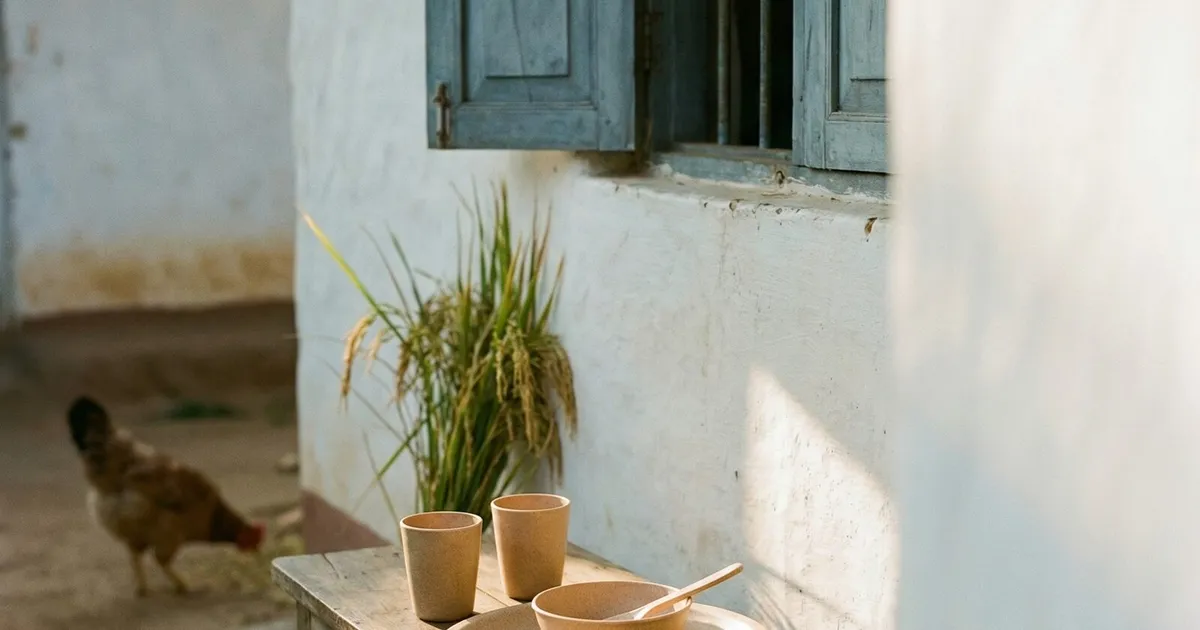
The first plate we ever pressed in our Moraiya unit came out warm, a little lopsided, and smelled — genuinely — like a rice field after the monsoon. That smell stayed with me. It was the cleanest thing I had held in a long time. That moment is what Aura Farmers, as a name, is trying to protect.
The word “aura,” and why it earns its place on tableware
“Aura” is an old word. In Sanskrit-adjacent traditions, in yogic texts, in ordinary Indian speech, it has always meant the felt presence of a thing — the quality something radiates before you describe it. A room has an aura. A person has an aura. A meal, eaten off the right surface, has an aura.
In the last few years, the word has travelled. It has picked up new life online, especially among younger audiences. When people today say something has aura, they mean it carries itself — it has character, weight, an unmistakable energy. They are using the word the way their grandparents used it, just on a new platform.
That was useful to us. We wanted a brand name that meant something specific to the people buying rice husk plates for a wedding in Ahmedabad, and something specific to the twenty-two-year-old event planner in Mumbai who is choosing between a plastic plate and ours. The word “aura” bridges those conversations without losing its spine. It is not a borrowed word. It is a word the language has always had — one that the culture happens to be paying attention to again.
For a biodegradable tableware company in India, that felt like the right bet. The material already has presence. The name just had to be honest about it.
Why a plate needs presence at all
We are taught to think of disposable tableware as invisible. It arrives, it holds the food, it leaves. No one is supposed to notice it.
We think that is the wrong framing — and not for sentimental reasons. Disposable plates have quietly shaped how Indian meals feel at scale. Weddings of three hundred guests. Corporate canteens feeding a thousand people a day. Temple prasad counters. Train stations. In all of those settings, the plate is doing emotional work whether it is designed to or not. A flimsy pulp plate that collapses under dal tells the guest they were an afterthought. A styrofoam plate tells the planet the same thing.
Rice husk composite tableware behaves differently on the hand. It is rigid. It has a matte finish that is closer to stoneware than to paper. It has real weight. People pick up an Aura plate for the first time and — almost always — flex it slightly, look surprised, then ask what it is made of.
That surprise is the aura part. The material announces itself before the brand does. The name is just the word for what was already happening in the person’s hand.
”Farmers” — the second half of the promise
The simpler half of the name, and the half we will not compromise on.
Every Aura plate traces back to a farmer who grew a rice crop. Rice husk is not synthetic and it is not a lab-invented polymer — it is the outer shell of the grain, separated during milling, available in enormous quantity across India and historically treated as waste. Most of it gets burned in open fields, which is one of the reasons North India’s air quality collapses every winter.
We use that waste as our raw material. That is only possible because someone, somewhere in this country, farmed rice. “Farmers” is in the name because the supply chain starts with them, not with us. The word is a receipt. It reminds us, and anyone reading the packaging, that biodegradable tableware from rice husk is downstream of agriculture — not downstream of a petrochemical plant.
There is also a quiet point in the plural. Farmers, not Farmer. The raw material comes from many hands across many states, growing many seasons of many varieties. One farm does not feed this operation. An agricultural economy does. The name reflects that.
Naming conventions we walked away from
We went through roughly sixty name candidates. A few families of names we explicitly rejected:
Eco-prefixes. EcoLeaf, EcoPlate, EcoIndia, Eco-anything. The green prefix is so overused in this category that it has become invisible. If you search “eco-friendly plates India,” you will find two hundred brands with the same naming scheme. The product should speak for itself — not wear its label as a costume.
Tech-sounding suffixes. Biotech, ParticleX, Biosphere, AgroX. Cleantech naming conventions belong in infrastructure and investor decks, not on the side of a 12-inch dinner plate that someone is eating biryani off.
Founder’s name. Singh Tableware Co., HS Agroproducts, and variations. Not the identity we wanted. This is a product about a material and the people who grow it. It is not a product about me.
English-first sustainability jargon. Earthware. Greenware. Plateware. These words feel imported. The brand had to work in English and in Hindi, in a wedding catering WhatsApp group and in a pitch deck. Simple, rooted, unarguable.
What the name commits us to
Naming is not marketing. It is a promise that the product is going to have to keep paying off, one shipment at a time.
“Aura” means the plate has to actually have presence. Rigid. Matte. Warm to the touch. It has to feel substantial enough that a guest notices it — in a good way — and substantial enough that an event planner buying for three hundred covers does not get a callback about a collapsed plate at 9 pm.
“Farmers” means the supply chain has to stay traceable. It means we do not pivot, quietly, to cheaper synthetic binders when margins tighten. It means rice bran — the natural oils and proteins in the bran act as our binder under compression — stays the binder. No polymer substitutes dressed up in eco-language.
Both halves of the name make claims the company has to keep making good on. That is why the name stuck. Not because it was clever — there are cleverer names — but because it gave us a standard to measure ourselves against.
Why this matters if you are buying from us
Most people buying biodegradable tableware in bulk — wedding planners, canteen managers, temple trusts, procurement officers at institutions — are not going to read a brand’s origin story before placing the first order. We know that. Your first filter is price, decomposition timeline, FSSAI compliance, dispatch speed, and whether the plates hold up under gravy.
But names do work on the buyer, even quietly. A supplier called EcoLeaf #47 does not feel like it will still exist in three years. A supplier whose name commits it, in public, to the material and the farmers behind it — that is a company making itself accountable to something.
That is the bet we are making with the name. The plates have to keep earning it.
Aura Farmers makes biodegradable tableware — plates, bowls, cups, and cutlery — from rice husk and rice bran sourced across diverse Indian agricultural regions. Manufactured in Ahmedabad, Gujarat. For bulk and institutional orders, reach us on WhatsApp at +91 81403 47773.