

Why Rice Husk Makes Better Plates Than You Think
Most people assume eco-friendly means compromise. Here's why rice husk composite changes that assumption — and what makes it structurally superior to pulp or leaf plates.
The first time I walked into a rice mill on the outskirts of Ahmedabad, I remember the sound more than anything — the continuous hiss of husk being blown out of the grain and piled up behind the sheds. Mountains of it. Nobody wanted it. The miller told me he paid to have it carted away and burned.
That was four years before we started making plates out of it.
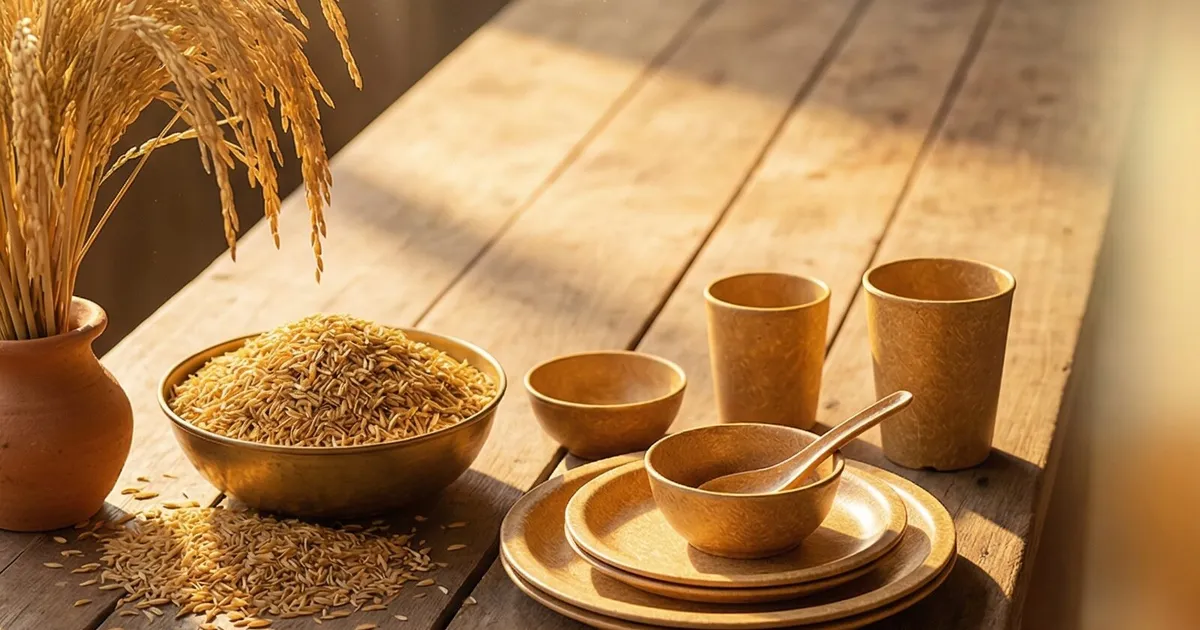
I’ve watched people pick up an Aura plate for the first time and do the same thing every time: flex it slightly, look surprised, then ask — what is this made of? That moment of surprise is the whole reason we exist. Rice husk composite doesn’t look or behave like what people expect from “eco-friendly” tableware. It’s rigid. It handles gravy. It doesn’t turn soft three bites in. And it decomposes in 60–90 days after use.
Here’s why the material works the way it does.
What rice husk actually is
Rice husk is the outer shell of a rice grain — the part removed during milling that has no food value. India generates over 22 million tonnes of it annually. Most of it is either burned in open fields (a serious air pollution problem across North India and Punjab) or left to rot.
It’s an agricultural waste stream with no natural end market. Which makes it an interesting raw material — abundant, cheap, and nobody wants it.
The structural case for husk composite
Leaf plates (sal, banana, areca) are the traditional comparison. They’re natural, they compost. But they have real structural limits: thin walls, inconsistent thickness, and they soften quickly with moist food.
Pulp plates (moulded paper) are more common in commercial settings. Better structure than leaf, but they absorb water. Leave a pulp plate under a curry for ten minutes and it starts to go. They also require bleaching in most industrial processes.
Rice husk composite is different for two reasons:
1. Silica content. Rice husk is naturally high in silica (roughly 20% by weight). Silica is what makes glass hard. In the composite mix, it contributes structural rigidity without adding synthetic material. The plate holds its shape because of the raw material’s natural chemistry — not a plastic coating.
2. Compression moulding. The husk-and-bran mix is formed under high heat and pressure (180–200°C). No water added during forming, which means no moisture absorption post-production. The resulting structure is dense and resistant to liquids in ways that pulp can’t match.
Why the bran matters
Rice bran — the inner layer between husk and grain — acts as the binding agent in the composite. It contains natural oils and proteins that, under heat and pressure, bind the silica-rich husk particles together without synthetic adhesives.
This is the part that gets overlooked in marketing copy about “eco-friendly plates.” The binder is usually where synthetic chemicals enter the picture in competing products. In rice husk composite done right, the bran is the binder. The chemistry is entirely agricultural.
What this means in practice
- Oil and moisture resistance: Handles curries, dals, and wet foods without softening. The silica structure doesn’t absorb.
- Microwave safe: No plastic coating means no leaching concern. The plate can go in a microwave.
- Shelf life: 12 months unused in dry storage. The material is stable because it’s essentially compressed and cured — not a living or hygroscopic material like paper pulp.
- Decomposition: After use, the natural materials break down within 60–90 days in composting conditions. In soil, they return to the same cycle that produced them.
The honest trade-off
Rice husk composite isn’t perfect. It’s heavier than a pulp plate — perceptibly so. For some event formats where staff are stacking and carrying large numbers, that weight adds up.
It’s also more expensive to produce than pulp. The compression moulding process requires precise temperature and pressure control, and the raw material (while waste) still needs collection, cleaning, and processing infrastructure.
What you get in return: a plate that behaves like real tableware. That’s the trade-off, and for anyone who has watched a pulp plate collapse under a full meal, it’s not a difficult one.
Aura Farmers tableware is made in India, from rice husk and rice bran sourced across diverse agricultural regions. All products are FSSAI food-safe compliant.